
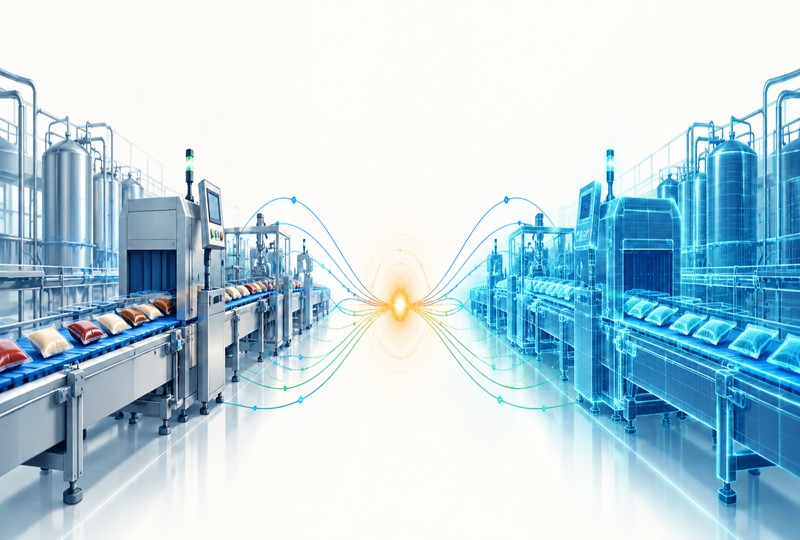
How can industrial companies save energy without compromising production? In the SPARK-TWIN research project, three companies from Germany and Belgium are developing digital twins that combine simulation, real-time data, and AI to improve process efficiency and reduce energy costs.

ChatGPT
The research project aims to make advanced energy optimization methods accessible to small and medium-sized industrial companies in the Meuse-Rhine Euroregion.
Industrial production processes often involve complex interactions between heating, cooling, and manufacturing operations. Identifying potential energy savings without compromising production reliability requires a detailed understanding of how systems behave under different operating conditions.
Digital twins offer a way to analyze and optimize such processes. By combining simulation models with real operating data, companies can better understand their systems, identify inefficiencies, and investigate alternative operating strategies.
The SPARK-TWIN project aims to make this technology accessible to smaller manufacturing companies, which often have limited personnel and technical resources.
A digital twin is a dynamic virtual representation of a physical system or process. In SPARK-TWIN, simulation models will be combined with data from connected sensors to monitor and represent actual operating conditions.
Artificial intelligence complements simulation by supporting predictions, detecting anomalies, and identifying opportunities for more energy-efficient system operation.
By combining simulation, real-time monitoring, and AI, the project aims to enable more informed operational decisions and improve process control.
SPARK-TWIN focuses on applications in the food processing industry, where energy-intensive heating, cooling, and batch processes offer significant optimization potential.
The technology will be tested at one pilot site: a production line operated by the Belgian food manufacturer Saveurs du Chef.
The demonstration will generate operating data to assess improvements in process control, potential energy savings, and the transferability of the approach to other industrial applications.
TLK Energy contributes its expertise in dynamic simulation of thermal systems and mathematical optimization to the project.
In developing the digital twin, we draw on our experience in modeling complex systems using Modelica and specialized model libraries such as the TIL Suite and the Process Systems Library.
Dynamic simulation models make it possible to represent the behavior of industrial processes using physics-based models, analyze operating conditions, and investigate more energy-efficient operating strategies. Using the open standard Functional Mock-up Interface (FMI), these models can also be used outside their original modeling environment and integrated with real measurement data and AI-based methods.
We also bring our experience in industrial energy consulting to the project. Through data analysis and pinch analysis, complemented by simulation where needed, we identify energy-saving opportunities and develop measures to reduce energy consumption and operating costs in industrial facilities.
A key objective of SPARK-TWIN is to develop a modular solution that can be adapted to different industrial processes and production environments.
The system is being designed for implementation by external specialists and straightforward operation afterwards. This will allow smaller companies to benefit from simulation-based and AI-driven optimization methods without having to develop extensive in-house simulation expertise.
Through cross-border collaboration, SPARK-TWIN aims to demonstrate how digital twins can contribute to more efficient production, lower operating costs, and more sustainable operation of industrial facilities.
SPARK-TWIN runs from January 2026 to December 2027 and brings together three project partners: TLK Energy GmbH (Germany), Boolean (Belgium), and Saveurs du Chef SRL (Belgium).
The SPARK-TWIN research project is co-funded by the European Union through the European Regional Development Fund (ERDF) under the STIPP funding initiative of the Interreg Meuse-Rhine (NL-BE-DE) programme.
More info you find on the official SPARK-TWIN project page.
© 2026 TLK Energy. All rights reserved.


